Understand requirements thoroughly
Customer technical and service requirements are expected to be fully understood before production or delivery begins.
This section presents PRIME ROCK's quality commitments in a clear executive format. It consolidates the company's quality policy, quality management system objectives, production control logic, technical validation practices, and calibration-backed confidence into one structured review page.
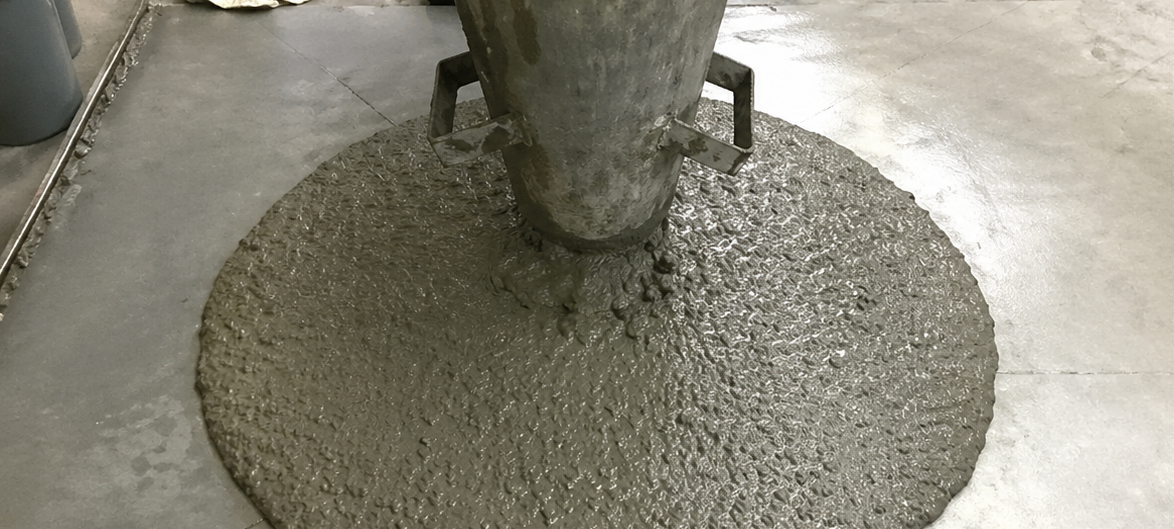
Controlled mix design supports consistent concrete performance.
PRIME ROCK states that its policy is to supply high quality ready-mixed concrete to the complete satisfaction of its customers while protecting long-term customer relationships. The policy ties product quality directly to customer requirements, international standards, and applicable regulatory obligations.
The section also makes a stronger operational claim: continuous improvement in quality is the responsibility of every employee, and management supports that commitment through training, process discipline, and periodic review.
It is PRIME ROCK's policy to supply high quality ready-mixed concrete to the complete satisfaction of valued customers. The purpose is not only to meet a specification once, but to preserve an enduring relationship between PRIME ROCK and the customer through dependable quality and service.
The policy states that concrete must comply with customer requirements, international standards, and applicable regulatory requirements. Continuous improvement is assigned to every employee, and the company links its future success to meeting or exceeding those expectations.
PRIME ROCK also connects quality to productivity: by embracing current technology, improving mix design discipline, strengthening on-time delivery systems, and maintaining robust quality control processes, the company passes efficiency and consistency benefits to its customers.
The policy extends beyond product performance. PRIME ROCK commits to training employees, providing a safe and healthy working environment, and preventing pollution to the environment. Management reviews the policy to ensure the quality management system remains suitable, effective, and aligned with ISO-based operation.
Customer technical and service requirements are expected to be fully understood before production or delivery begins.
The quality policy is measured through delivery performance and customer satisfaction, not only internal inspection.
Internal controls are expected to align with ISO requirements as well as applicable legal and municipal obligations.
Employees are expected to improve concrete and service quality as an active part of the quality management system.
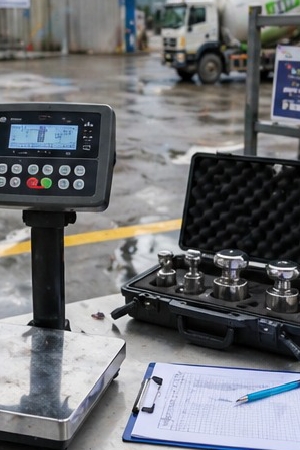
Computerized batching plants and high-precision scales are positioned as essential tools for dependable manufacture.
Staff capability and suitable working facilities are treated as required inputs for high-quality concrete supply.
Mix designs are developed with reference to standards such as BS, ACI, ASTM, and local municipality guidelines.
The system is meant to be evaluated continuously so that process effectiveness keeps improving over time.
The section explains that survival and success in a competitive market depend on satisfying technical and delivery requirements while continuously improving internal effectiveness and efficiency. PRIME ROCK positions the QMS as the mechanism that moves the business toward system-dependent performance instead of personnel-dependent performance.
The stated objectives are to standardize processes, define measurable controls, handle non-conformity systematically, eliminate root causes, and communicate with customers in a way that captures market perception of both product and service quality.
The QMS is also designed to remove blame-based culture by defining responsibilities and authorities clearly. Information should move through the organization in a structured manner, and the quality of product and service should be guaranteed through documented, efficient processes.

Describes the infrastructure and interrelationship of departments, process capability expectations, employee competence, supplier suitability, complaint handling, failures, corrective and preventive actions, auditing, management review, and continual improvement.
Details activities in sequential order and provides the operational instructions used to perform daily work consistently.
Provide objective evidence that work has been performed. The resulting data is collected, measured, analyzed, and used to improve operations, processes, and management performance.
PRIME ROCK describes quality as a result of connected operating controls rather than isolated inspection. Approved customer requirements, batching discipline, site coordination, testing, QA/QC oversight, and calibrated equipment all work together to protect service quality.
This makes the technical function inseparable from the quality function. Production control protects consistency in the plant, while the technical team validates the mix, verifies raw materials, and confirms that fresh and hardened concrete continue to meet the intended performance criteria.
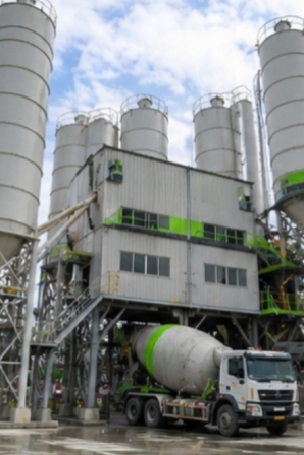
Production begins only from approved customer mix designs entered into the batching system and restricted to authorized personnel.
Materials are fed in the correct sequence with standardized mixing parameters for strength, workability, and durability.
Orders, vehicle movement, access, readiness, and service quality are coordinated before and during delivery.
Testing, QA/QC checks, data analysis, HSE awareness, and calibration keep the operating system accountable.
Approved mix designs are entered into the batching plant control system, uniquely identified, and restricted to authorized personnel only.
The order and quantity of materials fed into the mixer are standardized so the final product achieves the required strength, workability, and durability.
Storage requirements are defined, materials are kept separated, and transfer to the mixer is protected from contamination or foreign matter.
Shipping verifies orders, plans supply, coordinates dispatch, and aligns production with transport and site-readiness expectations.
Site checks cover access, pump space, readiness for casting, and field coordination needed to protect placement quality.
Plant performance is monitored, operating data is analyzed, and preventive maintenance supports dependable production conditions.

Supplier criteria are defined, supplier performance is evaluated, and technical staff verify material quality before production use.
Low- to high-strength mixes are designed and validated through laboratory and batching plant trials before production approval.
Fresh concrete, workability, temperature, and hardened concrete strength are checked under defined quality assurance procedures.
Concrete and raw material test data are analyzed to track deviation, supplier consistency, and ongoing process stability.

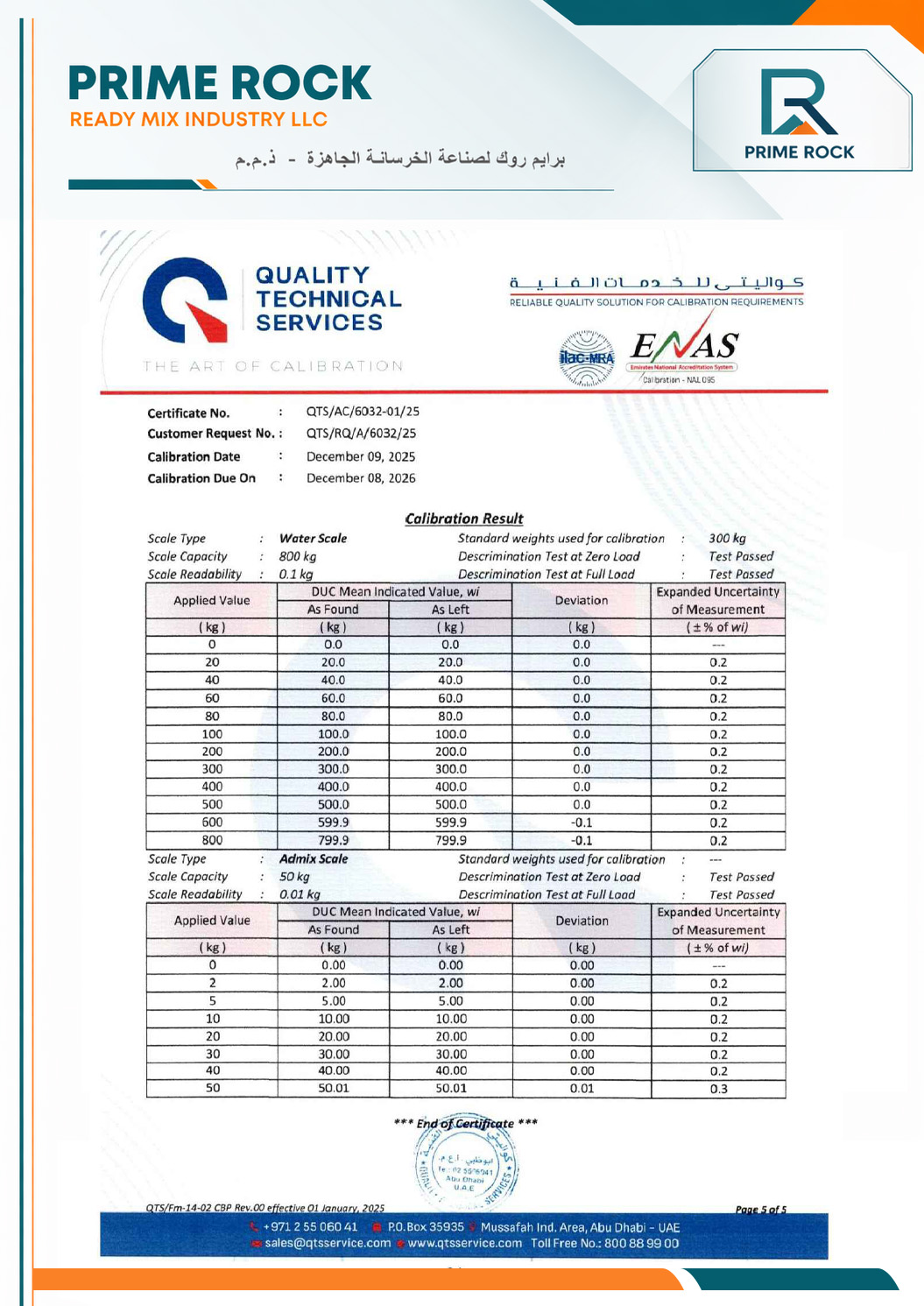
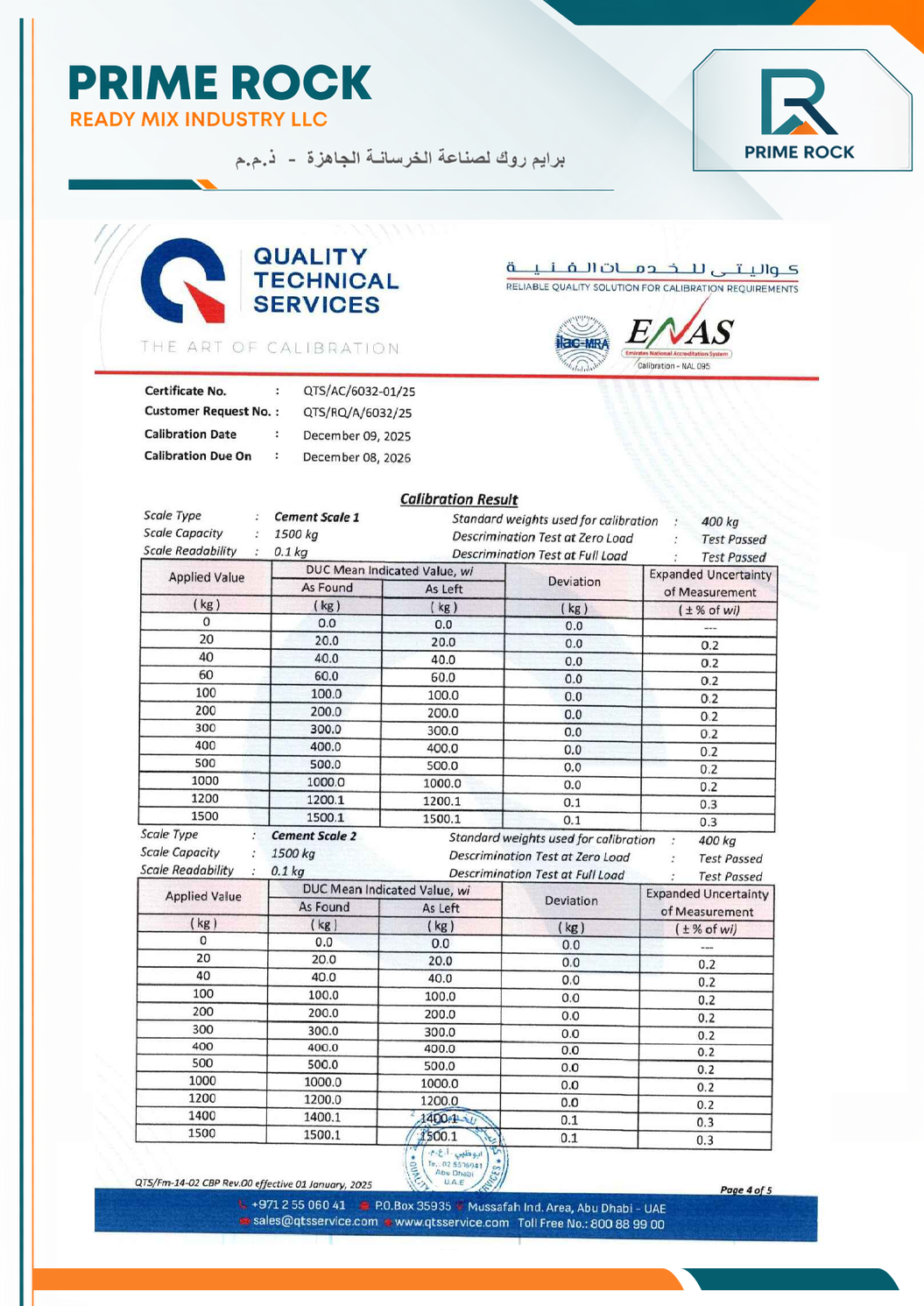
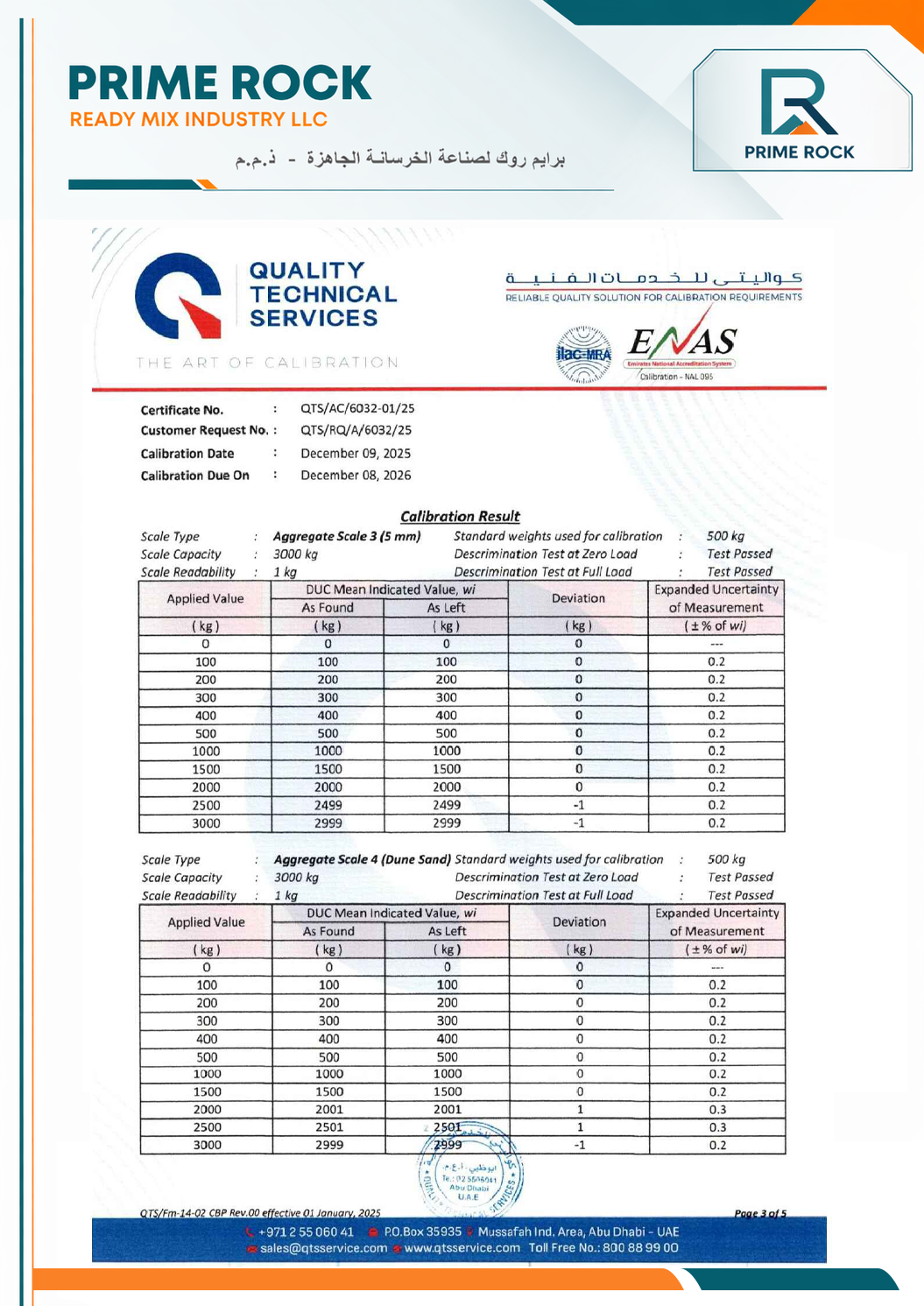
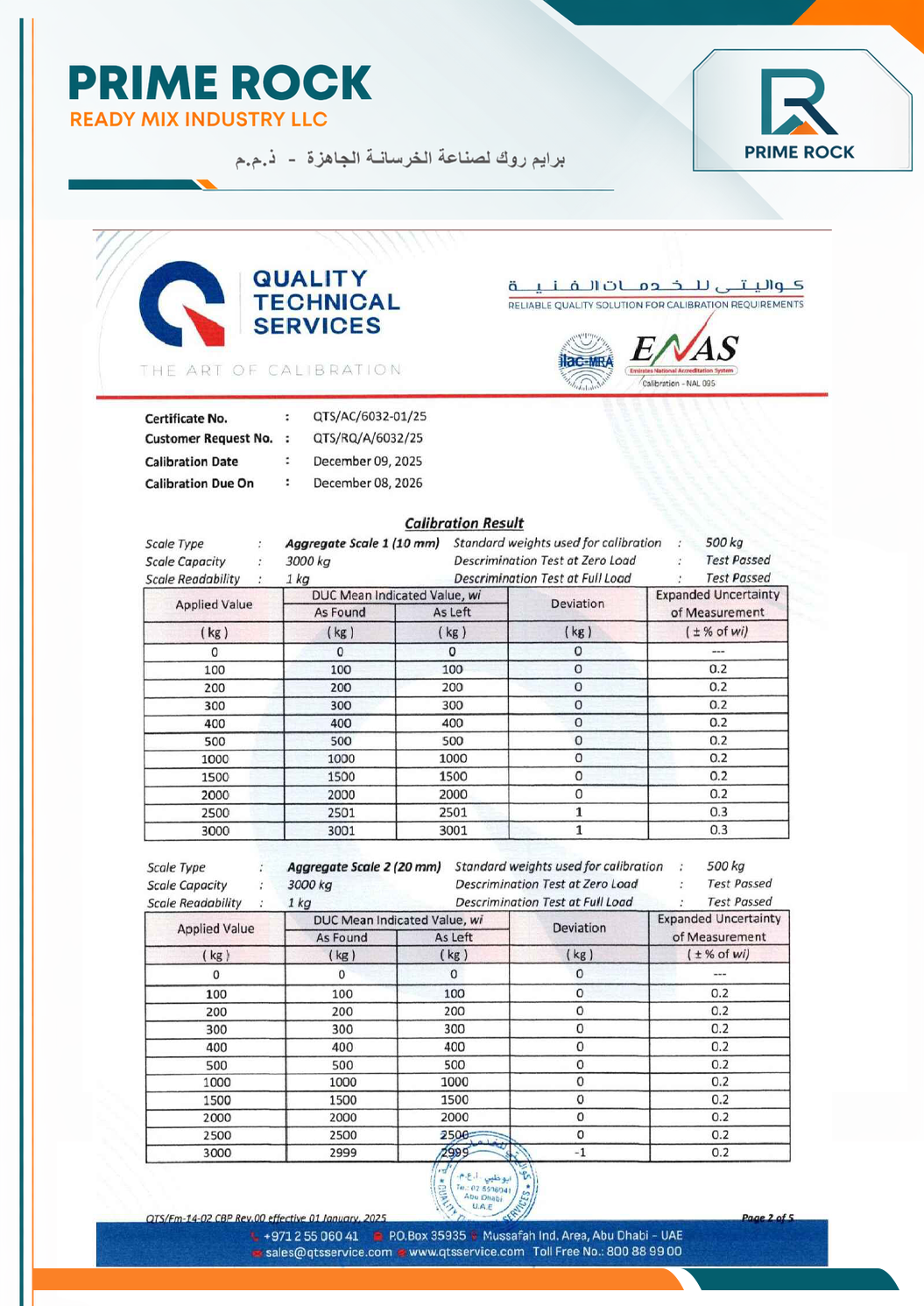
These five pages are presented here as supporting quality and system-control evidence. They reinforce the section's emphasis on process discipline, measurement confidence, and documented operational control.
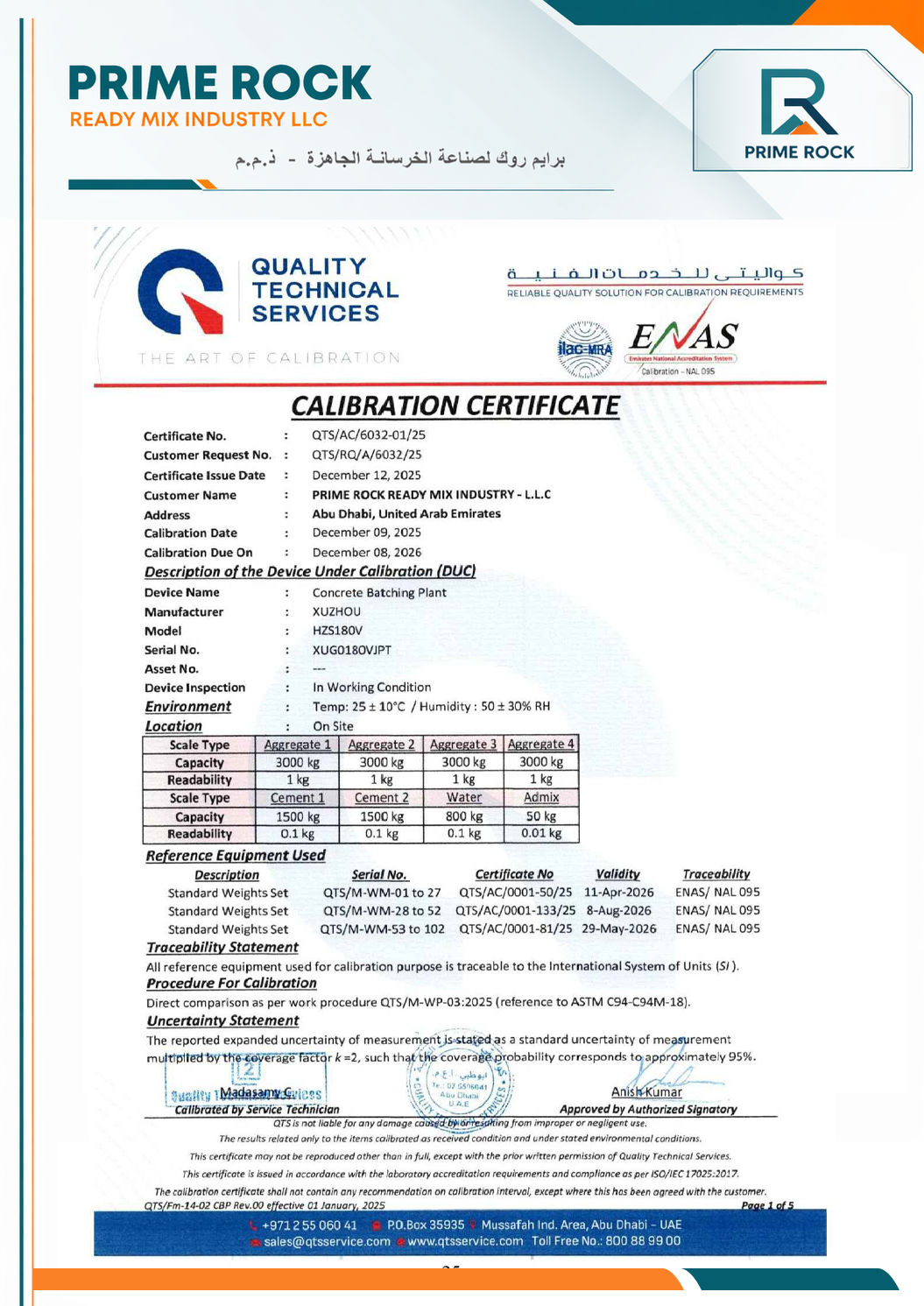
Certificate overview showing batching plant identity, reference equipment, and traceability details.
Aggregate scale calibration results for the batching plant under controlled measurement conditions.
Additional aggregate scale measurements documenting scale consistency and accepted deviation levels.
Cement scale calibration results documenting measurement confidence across the operating range.
Water and admixture scale calibration results completing the evidence set for plant measuring devices.